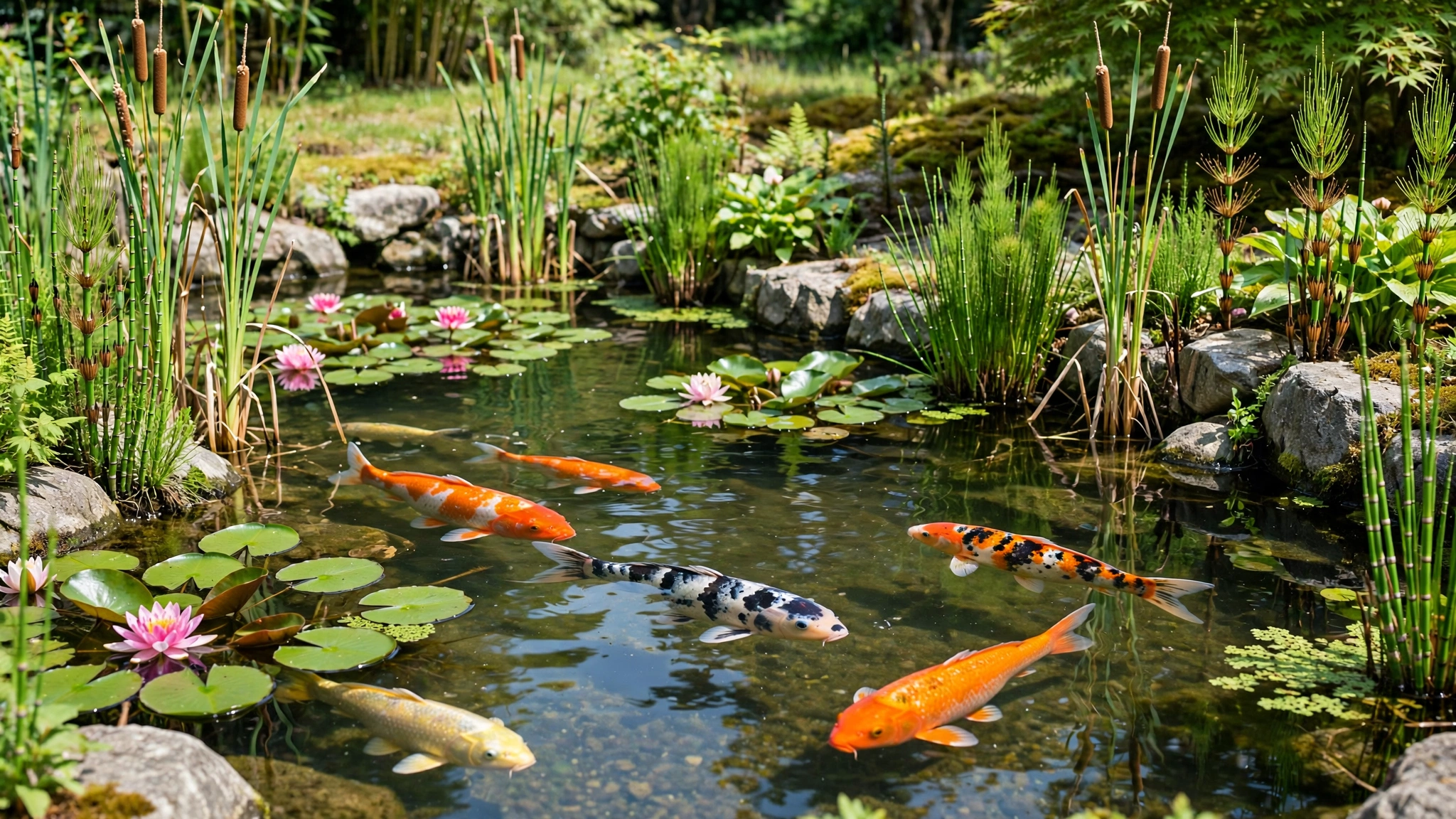
The best pond plants for koi ponds are the ones that can survive the fish themselves. Koi are large, strong, curious, and hungry, and they treat a pond like a buffet and a building site at the same time. They nibble soft leaves, chew dangling roots, and root through the bottom in search of food, and a delicate plant can be shredded or uprooted in a single afternoon. That does not mean a koi pond has to be bare. With the right species and a little protection, a koi pond can be green, shaded, and full of flowers — you just have to choose plants the way a koi keeper chooses them, not the way a water gardener with goldfish would.
This guide covers the koi pond plants that hold up best, the ones koi will eat (and how to use them anyway), and the practical protection methods — baskets, stones, floating rings, and protected plant zones — that keep plants alive in a pond full of big fish.
Why Koi Are So Hard on Plants
Koi are omnivores. In the wild, carp graze on soft vegetation, algae, insects, and whatever they find in the sediment, and domestic koi keep that behaviour. A koi will sample almost any new plant, and it will keep eating the ones it likes. Soft, fast-growing floaters such as water hyacinth and water lettuce are favourite snacks. Water lily leaves and roots get nibbled too, especially when the plants are young.
Eating is only half the problem. Koi also dig. A large koi can push gravel aside, tip a light basket, and pull a plant out by its roots while searching for food in the soil. In a pond with several big fish, an unprotected plant in a shallow basket is unlikely to last a season.
None of this means plants and koi cannot live together. It means three things matter more in a koi pond than in any other pond: choosing tough or fast-growing species, planting them properly, and giving the most vulnerable plants some form of protection. Koi also need good water quality, and plants help with that — they take up nitrates and phosphates, shade the water, and give fish shelter. The goal is a balance: enough plants to help the pond, planted in a way that the fish cannot destroy them.
Plants Koi Usually Leave Alone
These are the best plants for a koi pond if you want greenery that stays put. “Koi won’t eat” is never an absolute promise — a hungry koi will sample almost anything — but these species are tough, unpalatable, or fast enough to recover, and they are the ones experienced koi keepers reach for first.
Hardy Water Lily (Nymphaea spp.)
Water lilies are the classic koi pond plant, and for good reason: their broad pads shade the water, slow algae, and give koi somewhere to hide. Koi do nibble lily leaves and roots, so young lilies need protection, but an established hardy lily in a heavy basket can take a fair amount of grazing and keep growing. Choose a vigorous hardy variety rather than a delicate tropical one, and plant it in a wide, heavy container topped with large stones the fish cannot move. For more detail on planting depths and feeding, see our water lily care guide.
Lotus (Nelumbo nucifera)
Lotus is one of the toughest choices for a koi pond. Its leaves stand above the water on stiff stalks, out of easy reach, and its thick stems and leathery leaves are far less appealing to koi than soft lily pads. The tuber grows in a heavy container, and once the plant is established it is hard for fish to damage. Lotus needs full sun and warm water to flower, and it needs a wide pot — but in a large koi pond it is one of the most reliable show plants. Our lotus plant care guide covers planting and winter care.
Scouring Rush / Horsetail (Equisetum hyemale)
Scouring rush is a tall, jointed, bamboo-like marginal plant with silica-rich stems that koi generally ignore. It grows in a few inches of water at the pond edge, filters the water, and can be trimmed or grazed without harming the plant. It is very hardy and spreads by rhizome, so grow it in a container rather than loose in the pond, or it will take over the margin. Its upright form also adds structure that soft, leafy plants cannot.
Pickerelweed (Pontederia cordata)
Pickerelweed is a sturdy marginal with glossy heart-shaped leaves and spikes of blue flowers through summer. Koi rarely bother it once it is established, partly because it grows on a shallow shelf where big fish spend less time, and partly because its leaves are tougher than those of most floaters. Plant it in a basket on a shelf 2–6 inches deep, and protect the basket with stones until the roots are anchored.
Louisiana Iris (Iris fulva hybrids)
Louisiana iris and blue flag iris are marginal plants with stiff, sword-like leaves that koi leave alone. They flower in late spring, tolerate wet soil and shallow water, and form dense clumps that stabilise a pond edge. Their toughness is their defence: there is little soft growth for a koi to chew, and the rhizomes sit in a basket under a layer of gravel.
Dwarf Cattail (Typha minima)
Dwarf cattail gives a koi pond vertical interest without the aggressive spread of full-size cattails. Its narrow leaves are unpalatable, and it grows in shallow water at the edge, where koi rarely root around. Keep it in a container — even dwarf cattails spread by rhizome — and cut back dead foliage in late winter before new growth starts.
Vallisneria / Eelgrass (Vallisneria spiralis)
Vallisneria is one of the best submerged oxygenators for a koi pond, and one of the most koi-resistant. Its long, ribbon-like leaves grow from a buried crown, and koi rarely graze them. It does best in deeper water, where its wavy leaves provide habitat and shade without crowding the surface. Because it spreads by runners, it can fill a protected area of the pond floor and recover quickly from any nibbling.
Hornwort (Ceratophyllum demersum)
Hornwort is a free-floating submerged plant that needs no planting at all — it simply drifts in the water, taking up nutrients and giving young fish shelter. Koi nibble it occasionally, but it grows fast enough to keep up, and because it is not rooted, the fish cannot uproot it. It is also one of the most useful oxygenating plants for a koi pond, and it is cheap enough to replace if the fish eat more than expected.
Plants Koi Will Eat — and How to Use Them Anyway
Some of the most useful pond plants are also koi favourites. That does not mean you should avoid them. It means you should treat them as sacrificial plants: fast-growing species you add knowing the fish will eat them, and that you replace or thin out through the season.
Water Hyacinth (Eichhornia crassipes)
Water hyacinth is a superb nutrient sponge. Its dangling roots take up nitrates directly from the water, and its rosettes shade the surface. Koi love it, and will eat both leaves and roots. In a koi pond, treat it as food and filtration in one: add a few rosettes inside a floating ring, let the fish graze, and add more as they are eaten. Two cautions: water hyacinth is banned or restricted in a number of US states and in some other regions, so check local rules before buying it, and never release it into a natural waterway.
Water Lettuce (Pistia stratiotes)
Water lettuce is similar: soft rosettes, long roots, excellent nutrient uptake, and very popular with koi. It spreads quickly in warm water, which is an advantage here — the plant can outgrow the grazing for much of the summer. Like water hyacinth, it is tropical, so it will not survive a freeze, and it is restricted in some regions. Check local rules, and dispose of excess plants in sealed household waste, never in a stream or lake.
Duckweed (Lemna minor)
Duckweed is the ultimate sacrificial plant. Koi eat it readily, it doubles in days under good conditions, and it costs almost nothing to replace. A thin layer also shades the water and takes up nutrients. The risk is overgrowth: in a pond with few fish, duckweed can cover the surface completely, so thin it regularly and keep coverage to about a third of the surface.
Koi Pond Plants at a Glance
| Plant | Type | Koi resistance | Sun | Notes |
|---|---|---|---|---|
| Hardy water lily | Floating-leaved | Moderate — nibbled, needs protection when young | Full sun | Heavy basket, stones on top |
| Lotus | Floating-leaved | High — stiff leaves above water | Full sun | Wide container, warm water |
| Scouring rush | Marginal | High — silica-rich stems ignored | Full sun to part shade | Container only, spreads |
| Pickerelweed | Marginal | High once established | Full sun | Shelf 2–6 in deep |
| Louisiana iris | Marginal | High — stiff leaves | Full sun to part shade | Dense clumps, basket |
| Dwarf cattail | Marginal | High | Full sun | Container, cut back in late winter |
| Vallisneria | Submerged | High — rarely grazed | Full sun to part shade | Deeper water, spreads by runners |
| Hornwort | Submerged, free-floating | Moderate — nibbled but fast-growing | Full sun to part shade | No planting needed |
| Water hyacinth | Floating | Low — eaten readily, use as sacrificial | Full sun | Check local restrictions |
| Water lettuce | Floating | Low — eaten readily, use as sacrificial | Full sun to part shade | Tropical, check local restrictions |
| Duckweed | Floating | Low — eaten readily | Full sun to part shade | Thin regularly |
How to Protect Plants from Koi
Choosing tough plants is only half the job. In a pond with large koi, protection decides whether plants survive their first season. These are the methods that work, in order of importance.
1. Plant in Heavy Baskets and Top with Large Stones
This is the single most effective step. Plant lilies, lotus, and marginals in wide, heavy aquatic baskets filled with aquatic soil, and cover the soil surface with large, washed stones — roughly 20 mm gravel or bigger — that koi cannot push aside. The stones stop the fish from digging into the soil and clouding the water, and the weight of the basket stops it tipping. Do not use small gravel on top; koi will move it. Leave room in the basket for the plant to grow, and do not pack several unrelated plants into one container.
2. Use Floating Rings for Floaters
Floating plants are the most vulnerable because their roots hang in open water where koi can reach them. A floating ring — a simple loop of pipe, foam, or a bought plant protector — corrals the plants in one area and, with a shallow net underneath, keeps fish from reaching the roots. Put water hyacinth, water lettuce, frogbit, and duckweed inside a ring, and the plants can establish while the fish graze only what pokes through. Move the ring if one spot gets too much sun or shade.
3. Create a Protected Plant Zone
The most reliable long-term solution is a separate planted area that shares water with the pond but keeps fish out. This is often a shallow bog or gravel bed at one end of the pond, separated by rocks, mesh, or a low wall, with water flowing through it. Plants grow undisturbed in the protected zone while still filtering the pond water, and koi get the benefit without access to the roots. Plan this before building or rebuilding a pond if you can: a protected zone that is hard to reach is hard to maintain, so leave access for thinning and replanting.
4. Use Shallow Shelves with a Rock Barrier
Marginal plants on a shallow shelf are naturally safer than plants in deep water, because large koi prefer deeper water and are less comfortable nosing around a shelf. Make the shelf only an inch or two below the waterline, then drop off sharply beyond it, and place a barrier of sturdy rocks along the front edge of the shelf. The rocks stop koi swimming onto the shelf and hold the planting medium in place, while still letting a little water through to keep the roots moist.
5. Protect Submerged Plants with Mesh
Hornwort and Vallisneria can be protected by growing them behind mesh netting or inside a weighted mesh cage, open at the top so the plants can grow upward. This works well for a new planting: once the plants are established and spreading, they can usually cope with some grazing, and the mesh can be removed or moved to the next new plant.
6. Feed the Koi Well
Hungry koi eat more plants. Koi that are fed properly — good-quality koi food, fed more in warm water and less as the water cools — are less likely to strip a pond bare. This will not stop grazing entirely, but it reduces it, and it is the easiest protection method of all. Do not overfeed, though: uneaten food pollutes the water faster than plants can clean it.
Plants, Water Quality, and Pond Balance
Plants in a koi pond are not decoration. They are part of the filtration system. Submerged plants such as hornwort and Vallisneria take up nitrates and phosphates that would otherwise feed algae, floating plants shade the surface and keep the water cooler, and marginal plants filter runoff at the edge. A koi pond with healthy plants usually has clearer water and steadier water quality than a bare one.
Keep expectations realistic. Plants alone cannot carry a heavily stocked koi pond. Koi produce a lot of waste, and a pond with many large fish needs proper mechanical and biological filtration as well. Think of plants as a supplement to filtration, not a replacement for it. Aim for roughly a third to a half of the surface shaded by plants in summer, and thin floaters before they cover the whole surface — too much cover blocks light, reduces oxygen exchange, and can trap debris.
Quarantine new plants before adding them, just as you would quarantine new fish. Plants can carry parasites, snails, and bacteria, and a short quarantine in a separate tub breaks that cycle. Rinse roots, remove dead leaves, and check for hitchhiking pests before the plant goes into the pond.
Common Mistakes in Koi Ponds
- Planting lilies loose in gravel. Koi will dig them up within days. Always use a basket, and top it with large stones.
- Choosing delicate plants and hoping for the best. Soft, slow-growing species are food, not decoration, in a koi pond. Start with the tough species above.
- Letting floaters cover the whole surface. A covered pond looks green, but the fish below get less oxygen and less light. Thin floaters weekly in summer.
- Putting plants where you cannot reach them. A protected zone or a basket at the far side of a deep pond is hard to maintain. Keep planting areas accessible.
- Forgetting that koi grow. A small koi may leave a plant alone; the same fish at 60 cm long will not. Plan protection for adult fish, not for the fish you have today.
- Skipping quarantine. New plants can bring in pests and disease. A week in a separate tub is cheap insurance.
Frequently Asked Questions
Will koi eat all pond plants?
No, but koi will sample almost any plant, and they will eat soft, fast-growing species such as water hyacinth, water lettuce, and duckweed readily. Tough plants with stiff or silica-rich leaves — lotus, scouring rush, iris, pickerelweed, Vallisneria — are usually left alone, especially once established. Protection matters as much as species choice.
What are the best plants for a koi pond?
Hardy water lilies, lotus, scouring rush, pickerelweed, Louisiana iris, dwarf cattail, Vallisneria, and hornwort are among the best, because they are tough, fast to recover, or unappealing to koi. Add water hyacinth or water lettuce as sacrificial plants inside a floating ring if you want extra nutrient uptake and natural food for the fish.
How do I stop koi eating my water lilies?
Plant the lily in a wide, heavy basket, top the soil with large stones koi cannot move, and protect young plants with a mesh cage or a floating plant protector until they are established. A vigorous hardy variety recovers from nibbling better than a delicate one, and feeding the koi well reduces grazing.
Can I keep plants and koi in the same pond?
Yes. Most koi ponds benefit from plants, which shade the water, take up nutrients, and give fish shelter. The key is choosing koi-resistant species and protecting vulnerable plants with baskets, stones, floating rings, or a separate planted zone. A pond with no plants at all is harder to keep clear and gives the fish nowhere to hide.
Do pond plants help keep koi pond water clear?
Yes, as part of a balanced system. Submerged and floating plants absorb nitrates and phosphates, shade the water, and compete with algae. But plants alone cannot handle the waste of a heavily stocked koi pond — proper filtration is still essential, and plants work best alongside it, not instead of it.
Are water hyacinth and water lettuce safe for koi ponds?
They are safe for the fish — koi eat them happily — but they are banned or restricted in a number of US states and in some other regions because they can become invasive. Check local rules before buying them, keep them contained in the pond, and never release them into a natural waterway. Dispose of excess plants in sealed household waste.
Conclusion
A koi pond does not have to be a bare pond. The trick is to stop thinking like a water gardener and start thinking like a koi keeper: choose tough plants, plant them in heavy baskets under large stones, protect floaters with rings, and keep a sacrificial patch of fast growers for the fish to graze. Hardy water lilies and lotus give you flowers and shade, scouring rush, iris, and pickerelweed hold the edges, and hornwort and Vallisneria work underwater where the fish rarely bother them. Add good filtration, feed the koi well, and thin the floaters before they take over, and the plants and the fish will look after each other for years.