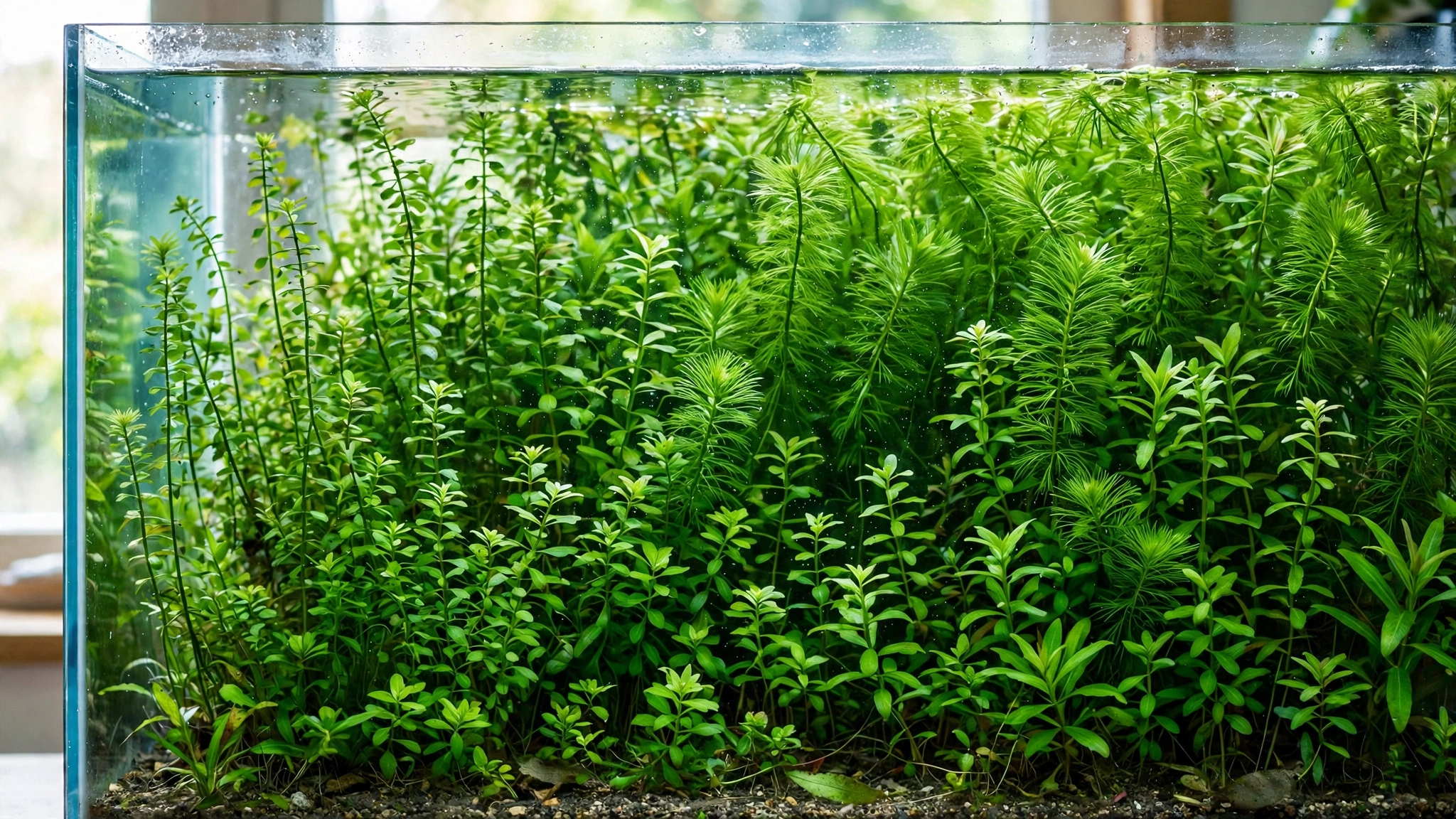
Fast growing aquarium plants are the quickest way to turn a bare tank into a green, lived-in aquarium. The fastest of these fast growing freshwater plants — Hornwort, Anacharis, Water Wisteria, and Water Sprite among them — can add several inches of growth in a single week under good conditions, and they start competing with algae for nutrients almost as soon as they settle in. That speed makes them ideal for a new setup, a bare background that needs filling, or a tank recovering from an algae outbreak. It also comes with a trade-off: fast growers need regular trimming, or they will shade their neighbours, crowd the swimming space, and eventually work against the balance they helped to create.
This guide covers ten reliable fast-growing freshwater plants, explains why they grow so quickly, and shows how to manage them — trimming, spacing, light, and feeding — so the tank stays healthy rather than overgrown.
Why Some Aquarium Plants Grow So Fast
A plant’s growth speed is mostly set by its species, then shaped by its conditions. Aquarium plants that grow fast share a few traits. Many are stem plants, which grow by extending a stem and adding new leaves at the tip, so a single cutting can become a tall plant in weeks. Others spread by runners — horizontal stems that form new plants at intervals. Floating plants skip the substrate altogether and put all their energy into leaf growth at the surface, where light is strongest.
Three conditions decide how fast these plants actually grow in your tank:
- Light. More light generally means faster growth, up to a point. Most plants in this guide grow well under low to moderate light. Very strong light without enough nutrients and carbon dioxide (CO2) tends to grow algae faster than plants.
- Nutrients. Fast growth uses up nutrients quickly. Fish waste supplies some nitrogen and phosphorus, but a heavily planted tank usually needs a regular liquid fertiliser as well. Root-feeding plants also benefit from a nutrient-rich substrate or root tabs.
- Carbon dioxide. CO2 is not required for the plants in this guide, but adding it speeds up growth further, especially for stem plants such as Rotala. The trade-off is that faster growth means more frequent trimming.
Temperature matters too. Most fast growers are tropical or subtropical plants that grow best between about 20 and 28°C (68–82°F). In a cold tank they slow down noticeably, and some, such as Anacharis, prefer the cooler end of that range.
Fast-Growing Aquarium Plants at a Glance
| Plant | Growth rate | Light | CO2 needed? | Best placement |
|---|---|---|---|---|
| Hornwort | Very fast | Low–high | No | Floating or background |
| Anacharis (Egeria densa) | Very fast | Low–moderate | No | Background or floating |
| Water Wisteria | Very fast | Moderate | No | Background or midground |
| Water Sprite | Very fast | Low–moderate | No | Background or floating |
| Guppy Grass | Very fast | Low–moderate | No | Background or floating |
| Vallisneria | Fast | Low–moderate | No | Background |
| Hygrophila polysperma | Fast | Low–moderate | No | Background or midground |
| Rotala rotundifolia | Fast | Moderate–high | Helpful | Background or midground |
| Brazilian Pennywort | Fast | Moderate | No | Background or floating |
| Duckweed | Very fast | Low–high | No | Surface |
1. Hornwort (Ceratophyllum demersum)
Hornwort is often the first plant people recommend when they want fast coverage. It has no true roots, so it can be left floating or weighed down in the substrate, and it grows several inches per week under moderate light. Its feathery, dark green needles grow in whorls around the stem, giving fry and shrimp excellent shelter. It tolerates a wide range of water conditions — roughly pH 6.0–7.5 and 15–30°C (59–86°F) — and needs no CO2 or special fertiliser. The main drawback is its speed: left alone, it can cover the surface and shade everything below it. It also sheds needles when conditions change suddenly, so expect some mess after moving it. Trim the stems regularly and remove the cuttings, because Hornwort will keep growing wherever it lands.
2. Anacharis (Egeria densa)
Anacharis, also sold as Brazilian Waterweed or Elodea, is one of the hardiest fast growers available. Its bright green stems, with small leaves arranged in whorls, can grow several inches per week and reach lengths of a metre or more if never trimmed. It can be planted in bunches or left floating, and it does well in low to moderate light without CO2. It prefers cooler water than most tropical plants — roughly 15–28°C (60–82°F) — and can struggle in very warm tanks. Because it grows so vigorously, it is a strong competitor for nutrients, which is exactly why it helps against algae in a new tank. Be aware that it is considered invasive in some regions, so never release it, or any aquarium plant, into natural waterways. Dispose of trimmings in sealed household waste.
3. Water Wisteria (Hygrophila difformis)
Water Wisteria is a stem plant with delicate, lace-like leaves that change shape depending on conditions: submerged leaves are finely divided, while leaves grown above the water look quite different. It is one of the fastest stem plants in the hobby, typically adding several inches per week in a healthy tank. It does best in moderate light and temperatures around 21–28°C (70–82°F), and it grows well without CO2. It can be planted in the substrate or left floating, and it responds to trimming by branching, so regular cuts make it bushier rather than just shorter. Because it grows so tall, it suits the background or midground of a tank at least 30 cm tall.
4. Water Sprite (Ceratopteris thalictroides)
Water Sprite is a fast-growing fern that can be planted in the substrate or floated on the surface, where it forms a rosette of fine, lacy leaves. Planted, it grows into a bushy background plant; floating, it provides shade and shelter for fry, and its trailing roots give shrimp somewhere to graze. It grows quickly under low to moderate light, needs no CO2, and tolerates roughly 20–28°C (68–82°F). It is a heavy feeder from the water column, so regular liquid fertiliser helps it keep its pace. Like Hornwort, it can shed leaves when moved, so give it a week or two to settle. Thin it regularly, because a floating mat can block light from the plants below.
5. Guppy Grass (Najas guadalupensis)
Guppy Grass is a fine-leaved, delicate-looking plant that grows into a dense tangle surprisingly fast — stems can reach 90 cm (about 3 feet) if left untrimmed. It is named for the shelter it gives guppies and their fry, which hide in its dense growth. It can be planted or floated, grows in low to moderate light without CO2, and adapts to a wide range of water conditions. Its fine leaves trap debris, so a gentle shake in old tank water during a water change keeps it healthy. Because it grows in a loose tangle rather than neat stems, it suits a natural or jungle-style tank better than a formal aquascape. Trim it with scissors and remove the cuttings promptly.
6. Vallisneria (Vallisneria spiralis and Vallisneria americana)
Vallisneria, or Val, is a grass-like plant with long ribbon leaves that sway in the current. Instead of growing taller from a stem, it spreads through runners — horizontal stems that run along or just under the substrate and form new plants at intervals. A single plant can fill a background in a few months. It grows fast under low to moderate light, needs no CO2, and prefers a nutrient-rich substrate, since it feeds mainly through its roots. Jungle Vallisneria (Vallisneria americana) can grow leaves over a metre long, so it suits tall tanks; the narrower Vallisneria spiralis stays shorter and fits smaller setups. Plant each crown with its base at the substrate surface, not buried deeply, and thin out runners when they invade the foreground.
7. Hygrophila polysperma
Hygrophila polysperma, sometimes called Dwarf Hygro, is a tough stem plant that will take over a tank if it is not trimmed. It grows tall and dense, adapts to soft or hard water and a wide pH range, and thrives under low to moderate light without CO2 — one of the most forgiving fast growers for a beginner. Its speed is also its main demand: expect to trim the tops every couple of weeks in a well-lit tank. Cuttings replant easily — push a trimmed stem into the substrate and it will root within days. Note that this species is restricted or banned in some US states because it can become invasive in warm waterways, so check local rules before buying, and never release it outdoors.
8. Rotala rotundifolia
Rotala rotundifolia is a finer, more delicate stem plant than the others on this list, and it rewards a little more attention. Under moderate to high light it grows fast and forms a dense bush, especially when trimmed regularly; under strong light the leaf tips can turn pink or red. CO2 is not strictly required, but it helps the plant grow compactly and hold its colour. It suits the midground or background, where its thin stems add texture. Trim the tops and replant them to thicken a group, and remove older lower growth that has gone bare. It is a good choice when you want fast growth with a more refined look than the coarser stem plants.
9. Brazilian Pennywort (Hydrocotyle leucocephala)
Brazilian Pennywort is easy to recognise by its round, coin-shaped leaves on long stems. It grows fast in moderate light, can be planted in the substrate or left floating, and is often used as a background plant that trails across the surface. Floating stems grow fastest, since the leaves sit right under the light. It needs no CO2 and tolerates a range of conditions, but it does appreciate regular liquid fertiliser, since it feeds from the water column. Keep it trimmed back from the surface if it starts shading the tank, and remove any stems that grow out of the water and dry out at the tips.
10. Duckweed (Lemna minor)
Duckweed is the fastest plant on this list — a single tiny floating leaf can double in number in a matter of days under good light, and a few plants can cover a tank surface within a week or two. It absorbs nutrients directly from the water, which makes it very effective at competing with algae, and it provides shade and cover for shy fish. That speed is also the reason many aquarists regret adding it: it is very hard to remove completely, since any single leaf left behind will multiply. Use it only if you are happy to skim the surface regularly with a net, and never let it reach a drain or outdoor water. If you want a floating plant that is easier to control, consider Amazon Frogbit or Salvinia instead — both are covered in our floating aquarium plants guide.
How Fast Growth Affects Your Tank
Fast-growing plants do more than fill space. These quick growing aquarium plants build new tissue quickly, so they take up ammonia, nitrate, and phosphate from the water faster than slow growers. That is why they are so useful in a new tank: they help stabilise water quality while the filter bacteria establish, and they starve algae of the nutrients it needs. This does not replace testing — always check ammonia and nitrite with a test kit before adding fish.
There are limits, though. If the plants use up all the available nutrients, growth stalls and leaves turn yellow or transparent, so regular fertiliser and water changes keep the supply steady. Very dense growth also slows water flow, traps debris, and can lower oxygen at night, when plants consume oxygen instead of producing it. Keep some open swimming space, thin dense areas during maintenance, and make sure the filter outlet is not blocked by plant mass.
Trimming and Managing Fast Growers
Trimming is the core skill of keeping fast-growing plants, and it is simple once it becomes a habit. Trim a little every week or two, rather than letting the tank become a jungle and cutting it all back at once. For stem plants, cut the top few inches just above a leaf node; the remaining stem will usually branch from the node below the cut. Healthy cuttings can be replanted to thicken a group — but never released into the wild.
For runner plants such as Vallisneria, pull out unwanted runners by hand, taking the whole runner so it does not regrow from a fragment. For floating plants, skim off a portion of the surface cover with a net, leaving enough to provide shade but not so much that it blocks light from below. A useful rule is to keep surface cover below about a third of the tank surface unless you are deliberately shading the tank.
Spacing matters at planting time too. Stem plants grow into each other if planted in a tight bunch, and the lower leaves will die back from lack of light. Plant stems a few centimetres apart so light and water flow reach the lower leaves, and keep tall plants at the back so they do not hide the rest of the tank.
Do You Need CO2 or Strong Light?
Most plants in this guide grow fast without injected CO2 or strong light, and that is the point: they are fast growers for ordinary, low-tech tanks. Hornwort, Anacharis, Water Sprite, Guppy Grass, Vallisneria, and Hygrophila polysperma all grow well under low to moderate light with no CO2. Adding CO2 or stronger light will make them grow faster still, but it also increases the trimming workload and the risk of algae if nutrients run short.
A few plants on the list do want more light to perform at their best. Rotala rotundifolia stays greener and leggier in low light, and Water Wisteria grows more slowly and less densely. If your tank has only low light, choose from the low-light fast growers instead: Hornwort, Anacharis, Water Sprite, and Vallisneria are the safest picks. For more low-light options, see our low light aquarium plants guide.
Common Mistakes With Fast-Growing Plants
- Planting too many stems in one bunch. They shade each other, the lower leaves rot, and the bunch looks bare at the base. Space stems out.
- Letting floating plants cover the whole surface. Light cannot reach the plants below, and they stall. Skim regularly.
- Trimming everything at once. A heavy cut removes a large part of the tank’s nutrient uptake in one go. Trim in stages.
- Forgetting fertiliser. Fast growth uses nutrients fast. Pale or transparent new leaves often mean the plants have run short.
- Choosing a fast grower for a nano tank without a plan. In a 5-gallon tank, a stem that grows several inches a week will take over in days. Pick compact species instead — see our aquarium plants for small tanks guide.
- Dumping trimmings down a drain or into a garden pond. Many fast growers are invasive outside the aquarium. Bag trimmings and put them in sealed household waste.
Frequently Asked Questions
What is the fastest growing aquarium plant?
Duckweed is the fastest by sheer multiplication — it can double in days and cover a surface within a week or two. Among the fastest growing aquarium plants that are rooted or stem plants, Hornwort, Anacharis, and Water Wisteria are usually the quickest, adding several inches per week under moderate light. The exact speed depends on light, nutrients, temperature, and CO2.
Do fast growing aquarium plants need CO2?
No, not the species in this guide. Hornwort, Anacharis, Water Sprite, Guppy Grass, Vallisneria, and Hygrophila polysperma all grow fast in low-tech tanks without injected CO2. Adding CO2 speeds growth further and helps plants such as Rotala rotundifolia grow more compactly, but it is optional and it increases the trimming workload.
What are the best fast growing low light aquarium plants?
Hornwort, Anacharis, Water Sprite, and Vallisneria are the best fast-growing low light choices. They all grow well under low to moderate light without CO2, and they are hardy enough for beginners. Water Wisteria and Guppy Grass also manage in low light, though they grow faster with a little more.
How often should I trim fast growing aquarium plants?
Check them weekly and trim as needed — usually every one to two weeks for stem plants in a well-lit tank, less often in low light. Trim a little at a time rather than cutting everything back at once, and remove the cuttings from the tank so they do not rot and release nutrients back into the water.
Do fast growing plants help with algae?
Yes. Because they grow quickly, they take up ammonia, nitrate, and phosphate faster than slow growers, leaving less for algae. They work best as part of a balanced approach: stable light of 6–8 hours a day, regular water changes, and not overfeeding. Plants alone will not fix algae caused by too much light or too many nutrients.
Can I use fast growing plants in a new tank?
Yes — they are one of the best choices for a new setup. They establish quickly, give fish and shrimp shelter, and help stabilise water quality while the filter matures. Plant heavily from the start, keep the light to 6–8 hours a day, and test ammonia and nitrite before adding fish.
Conclusion
Fast growing aquarium plants are the quickest way to a full, healthy-looking tank. Hornwort, Anacharis, Water Wisteria, and Water Sprite will fill a new setup in weeks, while Vallisneria, Hygrophila polysperma, and Rotala add structure and texture behind them. Their speed is their greatest strength and their main demand: a little trimming every week or two keeps them working for the tank instead of taking it over.
Start with two or three species that suit your light and tank size, plant them with space to grow, feed them steadily, and trim on a schedule. Within a month, a bare tank can look established — and the plants will be doing quiet work the whole time, pulling nutrients from the water and keeping algae in check.
2 thoughts on “Fast-Growing Aquarium Plants to Fill Your Tank Quickly”